
Directors owe debts and lose contact with artists "go to work" at their own expense: The wage arrears in "Open Business" tear apart the underlying chaos of entertainment variety shows
Jiuzhi Network News On July 9,# multiple artists voiced their voices to collect debts # topped the entire Internet hot search. The shutdown farce of the cultural and tourism vari...
Jiuzhi Network News On July 9,# multiple artists voiced their voices to collect debts # topped the entire Internet hot search. The shutdown farce of the cultural and tourism variety show "Open for Business" broke into the public eye in an absurd and sad way. No one could have imagined that the glamorous artists in front of the camera would fall into the situation of "working in black": the executive director lost contact with 30 million yuan in debt, the camera team withdrew all equipment overnight, and seven resident guests worked hard to record for several days without any revenue. In the end, he announced that he would become a partner of the program at his own expense, trying to keep the project going.
Netizens gave this group of artists a playful and distressed title-"Seven Black Workers". This seemingly accidental variety show rollover is actually an inevitable outbreak of the long-term barbaric growth of small and medium-cost variety shows. Behind it lies the financial chaos and rights blind spots that have not been investigated in the industry for many years.
The variety show that collapsed in one or seven days: From high-profile start-up to empty buildings
This variety show, which focuses on "celebrities operating cultural and tourism stores offline", only took less than a week from its launch in Puning, Guangdong to its complete shutdown.
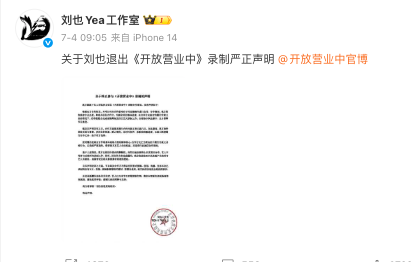
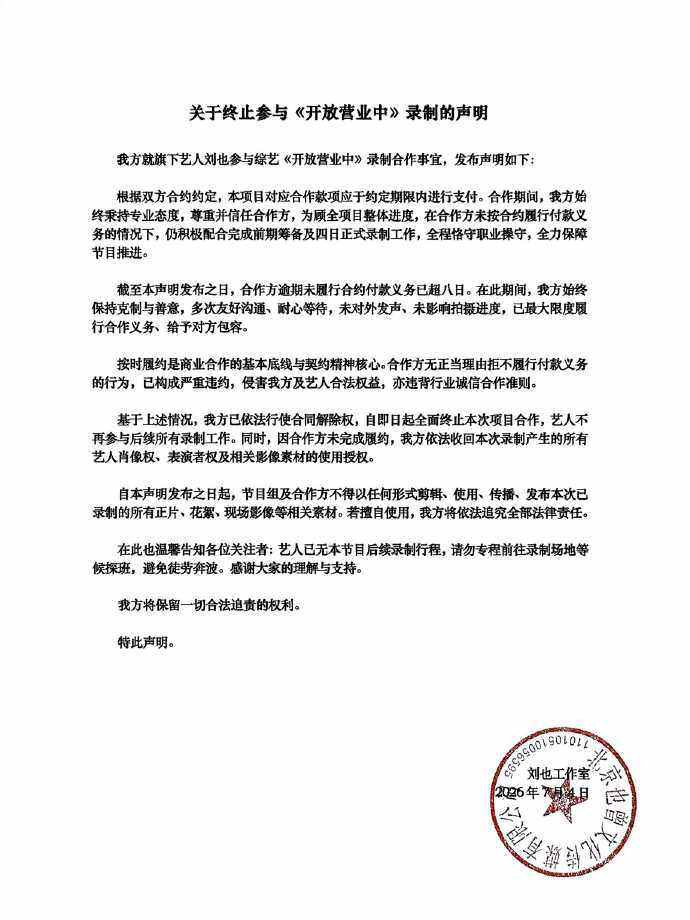
As early as July 4, the program had already turned red light: artist Liu Ye's studio issued a solemn statement stating that the partner had failed to pay the agreed labor remuneration for 8 days within the deadline, and had officially terminated the recording after repeated communication without success, and all image materials were withdrawn. authorization. At that time, most viewers only regarded it as an ordinary cooperation dispute, and no one expected that it was just the first piece of the dominoes.
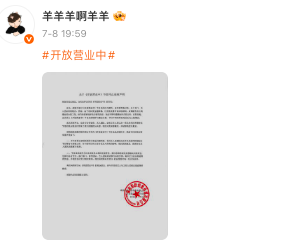
In the early morning of July 6, conflicts broke out completely. The camera team, which had been in arrears of salary for a long time, couldn't bear it anymore. They emptied all shooting equipment overnight and left the scene collectively. The general director Xiong Zhihao (online name "Yangyang") immediately lost contact. The next day, the artists went to the milk tea shop to prepare for work as usual. When they opened the door, they only left the empty venue and unfinished recording plans. Not to mention the follow-up remuneration, all the remuneration from the high-intensity shooting in the first ten days were wasted.
According to the original plan, this program would be fully recorded for 20 days. Guests would work from 9 a.m. to 12:30 a.m. every day. They would not only stand at the front desk to make drinks, receive visitors at the store, but also cooperate with live promotion and evening stage performances. Some on-site personnel revealed that Cao Enqi's arms were sore from shaking milk tea for a long time. Many artists worked so hard that their lips turned white and did not paddle at all during the entire process. What's even more ironic is that the situation of the grassroots team behind the scenes is even more difficult: a large number of staff members are unpaid interns recruited by "painting cakes", and even have to pay for their own travel and meals, and ultimately no revenue will be collected.
One day after the incident was fermented, the seven resident artists Lou Yixiao, Jiang Yiyi, Cao Enqi, Li Zhenning, Liu Zhang, Gao Siwen, and Gao Zhiting did not choose to leave the scene directly. Instead, they launched a live broadcast on July 9 to announce that all of them would become partners of the program at their own expense. They would pay for store operations and subsequent recording out of their own pockets. They would not only complete the program but also settle the accounts. From a guest who received remuneration to a boss who paid him, this outrageous identity reversal completely exploded the discussion of the entire incident.
2. 30 million yuan in old debts: This is not the first time I have run away with unpaid wages
As the incident delved deeper, more details emerged: the shutdown was not an accident of "temporary withdrawal of funds by investors" at all, but a debt explosion with a long warning.
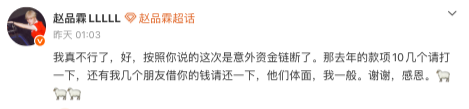
In the early morning of July 9, singer Zhao Pinlin took the lead in publicly issuing a document naming Xiong Zhihao, demanding hundreds of thousands of yuan in arrears in remuneration for another show last year, and also demanding that he return the millions of money he borrowed from his friends. In the comment area, many artists such as Lu Yi, Zuo Qibo, and Zhou Rui chimed in, revealing that they were also owed different amounts of labor costs, and the main body of the arrears was all the director surnamed Xiong.
Public information shows that Xiong Zhihao owed a huge debt of 30 million yuan for the production of "100% Singer" as early as 2025. At that time, there were cases where artists and staff collectively demanded salaries. Under the premise of carrying such a high debt, he can still operate new variety projects, even borrowing money from people around artists in the name of the project, privately inviting fans to dinner and using scalping tickets to induce loans. All kinds of operations have already exceeded the bottom line of the industry. What is even more noteworthy is that the company under his name has recently been added with information on the person subject to execution. It belongs to a veritable "dishonest entity", but it can still successfully connect with local cultural tourism projects and invite artists to start recording without any qualification review or funding threshold during the entire process.
Some industry insiders admit that the operating logic of such small and medium-cost variety shows has long been deformed: the producers first took the local cultural tourism cooperation intention and the list of artists to be invited to go to "empty gloves and white wolves", and dared to start the business after only 50% of the investment invitation was completed. The money received in the early stage first fills the hole in the previous project, and uses new debt to repay the old debt to snowball until the capital chain completely breaks and runs away. In the end, those who paid the bill were the artists and staff who had worked in vain, the local partners who had high hopes, and the ordinary audience who made a special trip to support them.
3. In-depth questioning: Who is giving the green light to the "streaking" variety show?
The reason why this wage arrears dispute has resonated across the Internet is not only because of the contrasting experiences of artists, but also because it has hit the three long-standing problems in the variety industry.
The first is the comprehensive gap in project fund supervision. Different from film and television dramas, which have relatively mature fund custody and account-sharing mechanisms, a large number of small and medium-sized variety shows, especially local cultural and tourism cooperative variety shows, have funds in and out completely controlled by the producers themselves, without third-party supervision or special restrictions on special funds. Producers can use project funds at will to repay private debts, and even shell companies can set up projects and start operations. After the accident, there is almost no constraint cost other than public opinion condemnation.
The second is the hierarchical dilemma of artists 'rights and interests. Leading artists often get high advance payments when signing contracts, and have a complete legal team to cover up the bill, so they will hardly fall into wage arrears disputes. However, waist artists, new generation artists and singers born in the draft generally have extremely low bargaining power, and many times they have to accept the unequal terms of "recording first and then settling" and "airing payment", and even accept low-priced, unpaid recordings for exposure opportunities. Once a producer runs away, rights protection will not only be time-consuming and labor-intensive, but may also be known as "difficult to cooperate" and affect subsequent resources. Most people can only suffer losses. This time, the seven artists chose to speak out collectively, which is a rare breakthrough in the industry.
The third is the qualification loophole for the barbaric growth of cultural tourism variety shows. In recent years, the combination of local cultural tourism and variety shows has become a popular trend. Many districts and county-level projects have limited budgets and prefer to find small and medium-sized production teams to cooperate. They lack review standards for the producers 'past qualifications, debt status, and financial strength. Many teams seized on this and used flashy project PPT to win cooperation. In fact, they did not have sufficient production funds at all, which ultimately damaged both the reputation of local cultural tourism and the rights and interests of artists.
Conclusion: Relying on hot searches to ask for wages should not be the norm in the industry
Today, seven artists have chosen to support the program at their own expense, in part to use their personal losses to cover the chaos in the industry. Their responsibility deserves recognition, but the industry's problems should not be borne by the artists 'sense of responsibility.
From wage arrears of crew members to running away from variety shows, labor disputes in domestic entertainment are no longer new. However, it is abnormal to rely on artists to post Weibo and search every time to promote solutions. A standardized fund custody mechanism, a clear set of entry thresholds for producers, and a smooth channel for grassroots practitioners to protect their rights are far more useful than ten hot searches for salary.
When the excitement in front of the camera fades, I hope this farce can really sound the alarm for the industry: the background of variety shows is creation, not a game in which capital is idle; the labor of practitioners should be guaranteed, not a bargaining chip for others to harvest. Otherwise, the next "empty building" recording scene will only come faster.
 白羊座
白羊座 金牛座
金牛座 双子座
双子座 巨蟹座
巨蟹座 狮子座
狮子座 处女座
处女座 天秤座
天秤座 天蝎座
天蝎座 射手座
射手座 摩羯座
摩羯座 水瓶座
水瓶座 双鱼座
双鱼座