"Nanjing Photo Studio" The Japanese Army took photos to show off the city massacre and how Liu Haoran preserved evidence of the massacre
The film "Nanjing Photo Studio", which is supervised by Fu Ruoqing and directed by the Olympic bid, starred by Liu Haoran, Wang Chuanjun, Gao Ye and Wang Xiao, starred by Zhou You,...
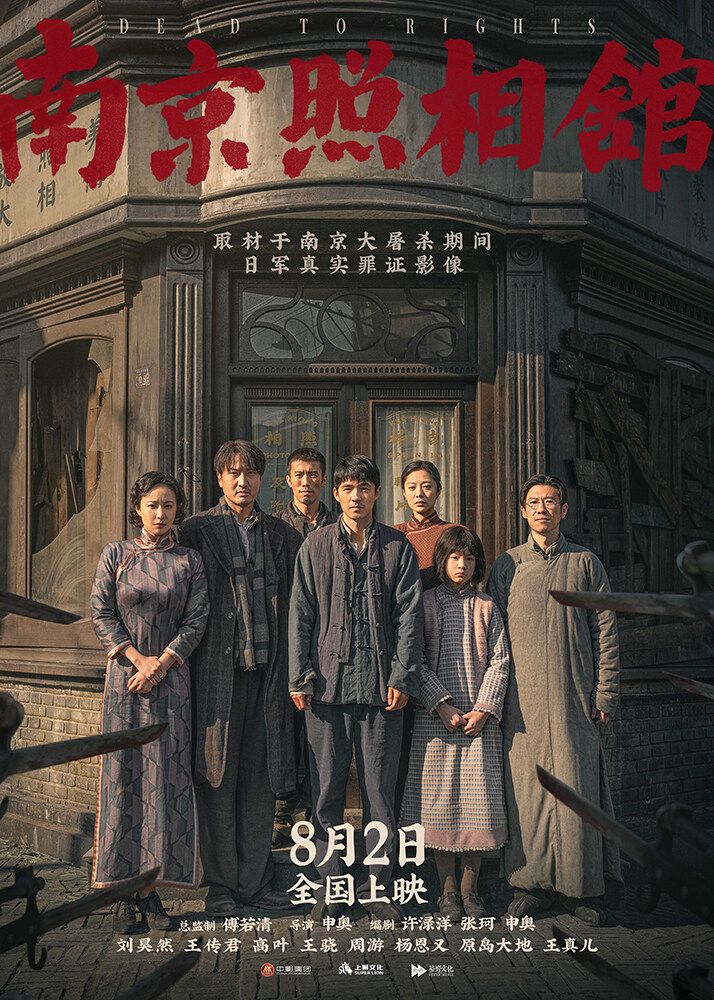
The film "Nanjing Photo Studio", which is supervised by Fu Ruoqing and directed by the Olympic bid, starred by Liu Haoran, Wang Chuanjun, Gao Ye and Wang Xiao, starred by Zhou You, starred by Yang Enyou and Harashima Dadi, and starred by Wang Zhener, will be released nationwide on August 2. The film released its first trailer for "Criminal Evidence Exposed" today, and simultaneously released a group portrait poster of "Family Portrait Under the Bayonet". The story of the film is based on images of the real criminal evidence of the Japanese army during the Nanjing Massacre. The trailer truly restores the numerous crimes of the Japanese army during the Nanjing Massacre and reveals to the audience the "where" the photos that proved the Japanese army's crimes came from-these criminal photos were actually taken by the Japanese army to show off the "achievements" of the massacre. The film tells the story of a group of ordinary people in Nanjing who took refuge in Jixiang Photo Studio. When they were forced to develop negatives for Japanese photographers, they accidentally produced irrefutable evidence that exposed the Japanese army's massacre of the city. Faced with the purgatory city of Nanjing at that time and the Japanese army's attempt to cover up crimes, how should they keep the photos and how will they pass them on?
Real impact! Liu Haoran Wang Xiao Photo Studio Darkroom Exposes Historical Truth
The trailer for the "Criminal Evidence Exposed" begins with the recitation of Nanjing nursery rhymes. Accompanying the scene of the Japanese army attacking the city, a chilling atmosphere hits your face, bringing the audience back to the Nanjing cold winter of December 1937. In the trailer, those iconic historical scenes that recorded the heinous crimes of the Japanese army were highly restored: the Japanese army took a group photo after the "Hundred Men Competition" to show off its "military exploits"; after the Japanese army captured Nanjing, they took photos of "victory" in front of the city gate; The streets of the city were littered with corpses, and countless people fell in pools of blood; A large number of China people were driven by the Japanese army to the riverside to be massacred, and the blood dyed the river red... The forecast was to mix the Japanese army's replacement camera film with the loaded bullet lens, which implied that they took the massacre as an "honor" to take photos, which was the "second massacre" of the victims.
The film focuses on a group of ordinary people who took refuge in Jixiang Photo Studio, depicting their psychological transformation and struggle during the darkest moments of the war. The Japanese army regarded the massacre as an "glorious" photographic record and forced them to develop the photos. A red light turned on in the darkroom, and photos recording the deaths of compatriots emerged in the developer, and a huge sense of guilt shrouded them. In order to survive, they had to develop photos for the Japanese army, but these photos were stained with the blood of their compatriots. They fell into hesitation and struggle: "The photos cannot be washed any more. If they are washed, they will be traitors." The Japanese army's swaggering atrocities, the tragic suffering of our compatriots, and the urgency of the survival of the nation, in the darkroom of the photo studio, these little people made a choice between life and death... Liu Haoran, who plays the postman A Chang, said when interpreting the characters: "Some things in their bones will be activated in times of disaster. If Nanjing becomes purgatory, what is the point of survival? They want to convey photos, but also want to convey hope." This group of small people who kept photos of the massacre in the city under the noses of the Japanese army are the glimmer of this dark history.
Don't be buried ! A new perspective shows the Japanese army's criminal evidence of the Nanjing Massacre
The film released a group portrait poster of "Family Portrait Under the Bayonets", exposing the character's shape for the first time. The people in the photo studio stood in the center of the picture, forcing their calm faces to hide their fear. The bayonets appearing around revealed that they were being coerced by the Japanese army to take photos. This situation and state are also the epitome of ordinary people living in Nanjing at that time. The design of the poster reflects an important historical fact during the "Nanjing Massacre" tragedy, that is, the Japanese army committed atrocities in China but did not want the atrocities to be exposed. Therefore, it coerced the people living in Nanjing to take "goodwill" photos and created false testimony to whitewash the peace.
The Japanese army took great pains to use false testimony to cover up the criminal evidence, but a group of ordinary China people, represented by A Chang, worked hard to preserve the criminal evidence and tried their best to expose the Japanese army's crimes. The film not only restores the historical scene during the "Nanjing Massacre" and exposes the shooting scenes of incriminating photos, but also shows the difficulty of exposing incriminating crimes and goes deep into the cruel back side of history. The director hopes that the film will show the survival struggles of ordinary people in extreme environments. He wants to use these truths to restore the historical scene to "expose the truth of evil and show the brilliance of human nature." At the same time, on the occasion of commemorating the 80th anniversary of the victory of the China People's War of Resistance Against Japanese Aggression and the World Anti-Fascist War, the determination to "remember history" is conveyed through a story of retaining criminal evidence.
The film "Nanjing Photo Studio" was produced by China Film Industry Group Co., Ltd., Beijing Shangshi Culture Group Co., Ltd., and Yuye (Shanghai) Culture Media Co., Ltd. Fu Ruoqing is the chief producer and director of the Olympic bid. Liu Haoran, Wang Chuanjun, Gao Ye and Wang Xiao lead the lead roles. Zhou You starred in the special role. Yang Enyou and Harashima Dadi starred, and Wang Zhener starred in the friendly role. It will be released nationwide on August 2.
 白羊座
白羊座 金牛座
金牛座 双子座
双子座 巨蟹座
巨蟹座 狮子座
狮子座 处女座
处女座 天秤座
天秤座 天蝎座
天蝎座 射手座
射手座 摩羯座
摩羯座 水瓶座
水瓶座 双鱼座
双鱼座