
Farewell, Star TV! 24 years of starlight have ended, and the youth of a generation has finally become a memory
At 0:00 on May 8, 2026, with the quiet interruption of satellite signals, Star TV, which has accompanied the post-80s and post-90s generation through 24 years of youth, officially...
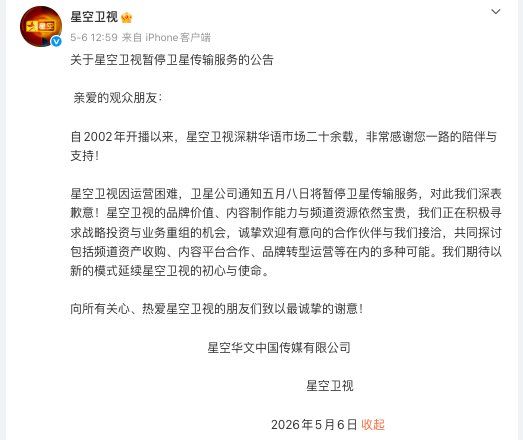
At 0:00 on May 8, 2026, with the quiet interruption of satellite signals, Star TV, which has accompanied the post-80s and post-90s generation through 24 years of youth, officially suspended satellite transmission services. On May 6, Star TV's official Weibo released an announcement, admitting that due to continued operating difficulties, this difficult decision had to be made. At the same time, it said that it would actively promote business restructuring and seek new possibilities such as asset acquisitions and platform cooperation in an attempt to retain the brand. A trace of vitality. But for countless viewers who grew up watching Star TV, this pause is more like the official curtain call of an era-those days of watching anime, watching idol dramas, and chatting about variety shows will eventually go away with the stars.
1. Set sail in 2002: Break down barriers and become the "pioneer window" for Chinese entertainment ***
On March 28, 2002, Star TV officially launched in Guangzhou. It is affiliated to Star Media, a subsidiary of News Corporation. It is the first overseas entertainment channel in China to obtain cable network landing rights before its launch. It was initially launched in the Pearl River Delta region of Guangdong. At that time, domestic entertainment content was relatively single, and online streaming media had not yet emerged. The emergence of Star TV was like a window to a diverse entertainment world, quickly catching the attention of young viewers.
In 2003, Star TV was approved for limited coverage across the country, covering foreign-related hotels with three-star or above and some foreign-related communities, allowing more viewers to have access to this fresh entertainment channel. In its heyday, it became the benchmark in the Chinese entertainment market with its golden content matrix of "anime + idol drama + original variety show":"Star Animation Pioneer" at 6 p.m. was the enlightenment of countless people in the daily comics, and classic animations such as "Naruto" and "One Piece""Wang","Inuyasha" and "Hundred Changes Sakura" accompanied a generation to spend the time after school. The plot was discussed during classes the next day, becoming a social ritual exclusive to youth; In the evening,"Asian Style Theater" introduced hit Hong Kong and Taiwan and Korean dramas such as "Meteor Garden" and "Full House of Romance", setting off a national idol drama craze. Stars such as F4 and Song Huiqiao became popular in the mainland with this; the original variety shows "The Devil Star Gaze" and "Beauty Pass" were bold and innovative, with both scale and interest, becoming the rare variety shows at that time that "dare to play and dare to shoot".
In 2002, Star TV produced more than 700 hours of original programming in its first year of launch; in 2003, it was named "Satellite Channel of the Year" by New Weekly, reaching its peak in influence. In those years,"Watching Star TV" was a symbol of young trends. It was not only a TV channel, but also an entertainment enlightenment and youth symbol for a generation of young people, carrying the purest happiness and memories.
2. Prosperity and decline: Under multiple pressures, the stars gradually fade *
After the high light, the crisis for Star TV has long been quietly buried, and what overwhelmed it was the multiple superposition of changes in the times, industry shocks and the lag in its own transformation.
The fatal contradiction between high costs and shrinking revenue is the direct trigger. The cost of satellite transmission is extremely high, and the annual rent of a single transponder exceeds 10 million yuan. However, in recent years, the traditional TV advertising market has continued to decline, and Star TV's advertising revenue has been greatly reduced. High costs and meager income have created a deadlock that is difficult to balance.
The rise of streaming media and the marginalization of traditional TV are the core impacts. With the rapid rise of Short Video and long video platforms, audience viewing habits have completely changed. Watching dramas, anime, and variety shows anytime and anywhere have become the mainstream. Star TV, which relies on satellite transmission and regularly broadcasts, has gradually been forgotten by young viewers. More importantly, it has long relied on traditional satellite models, failed to build an independent online platform in time, lacked user data accumulation, and was disconnected from communication channels. Even with classic IP, it was difficult to reach audiences in the new era.
Equity changes and limited content supply accelerated the recession. In 2014, Star TV was included under Star Chinese Media; in 2022, Star Chinese was listed on the Hong Kong Stock Exchange. It was once famous because of the "The Voice of China" controversy. However, in 2023, the "The Voice of China" controversy broke out, and the stock price of Star Chinese plummeted and the market value of Star Chinese plummeted. By May 2026, the stock price dropped to about 1 Hong Kong dollar, and the market value was less than 400 million Hong Kong dollars, directly affecting Star TV's operating investment. At the same time, in recent years, the threshold for the introduction of overseas variety shows and drama series has increased, and combined with insufficient content innovation, Star TV has gradually fallen into the dilemma of "old drama circulation and advertising accumulation" and lost its core appeal.
In addition, as an overseas channel, Star TV's landing scope has been limited for a long time, making it impossible to achieve nationwide popularization, further limiting the audience base and commercial value, and eventually transformed from "national memories" to "niche feelings" and gradually marginalized by the market.
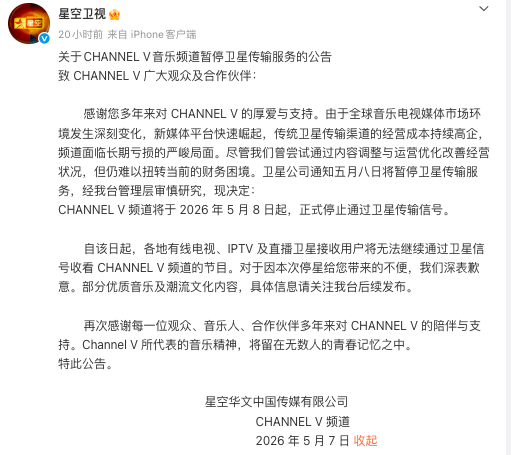
3. Youth is over: the tears of the times are also witnesses of growth
When the news came, the entire network was collectively caught in a "memory killing".# Star TV stopped airing # topics topped the Weibo hot search, with the number of readings exceeding 1 billion. Netizens left messages and lamented: "Childhood is gone, and youth is over.""When I was a child, I can't go back to the days of secretly watching Star TV.""I thought it had stopped long ago, but I didn't realize that youth has always been there."
For the post-80s and post-90s generation, Star TV is no longer a simple TV channel, but an "invisible partner" on the road to growth: it is the eagerness to go home from school and put down your backpack and immediately rush to the TV to wait for the animation to start; it is the ignorance of staying up late on weekends to watch idol dramas and shed tears for the love of the male and female protagonists; it is the warmth of watching variety shows with your family and the whole family laughed; it is the epitome of those simple and happy times without smartphones or short videos.
Today, Star TV's 24-year journey has come to an end, like a meteor streaking across the night sky, short but dazzling. Its end is not only the demise of a channel, but also the end of an era-the era when traditional TV-dominated entertainment, diverse content flourished, and youth was simple and pure, ultimately drifting away with the iteration of the media.
4. To be continued? Looking forward to the revival of stars and living up to the memories of youth
Despite the official announcement of suspending satellite transmissions, Star TV still retained the hope of "restructuring and returning" in its announcement, saying it would actively seek strategic investment and cooperation and explore new paths for brand transformation. Some people say that in the era of streaming media, classic IP will always be valuable. Star TV holds a large number of animation, film and television copyrights. If it can embrace the Internet and create an online content platform, it may be able to regain its new life; others believe that youth will ultimately not be restored. The beauty of Star TV will always stay in that specific era and be left in the memory of a generation, which is the best ending.
Regardless of whether the future can return, those youthful years accompanied by Star TV, those passionate anime, sweet idol dramas, and happy variety shows will never fade. 24 years of shining stars are enough to warm the long years; once the end comes, it will live up to the youth.
Farewell, Star TV; hello, our eternal youth.
 白羊座
白羊座 金牛座
金牛座 双子座
双子座 巨蟹座
巨蟹座 狮子座
狮子座 处女座
处女座 天秤座
天秤座 天蝎座
天蝎座 射手座
射手座 摩羯座
摩羯座 水瓶座
水瓶座 双鱼座
双鱼座